Travel has become much more digital. People now book flights on their phones and use smartphones to unlock hotel rooms. While this makes things easier, it also brings new cybersecurity risks for travellers.
Most tourists worry about lost luggage or flight delays, but few consider the risk of hackers stealing their data over airport Wi-Fi. However, cybercrime in the tourism sector is growing rapidly. Studies indicate that nearly 4 out of 10 travellers (about 40%) have had their information stolen while using public Wi-Fi, and many people connect to open networks without safeguards such as VPNs or security software.
This blog covers cybersecurity threats in tourism and how travellers can stay safe on public Wi-Fi and digital systems.
The Digital Transformation of Tourism
Tourism has become a highly digital industry. Travellers rely on technology for:
- Online flight and hotel bookings
- Digital boarding passes
- Navigation apps and travel guides
- Online payments and digital wallets
- Social media sharing during trips
However, these tools come with a new set of cybersecurity concerns that travellers must keep in mind as they plan their journeys.
According to recent research, 70% of tourists connect to public Wi-Fi networks, such as those found in airports, cafes, and hotels, without using protection like a VPN, exposing their personal data to potential risks.
Cybercriminals are aware of this. Crowded tourist spots with distracted travellers are perfect places for hacking attempts.
Why Tourists Are Easy Targets for Cybercriminals
There are several reasons why travellers are easy targets for cybercrime.
1. Distraction During Travel
Travellers are often tired, stressed, or in a hurry. They may quickly connect to any available Wi-Fi network without checking if it is secure.
Hackers exploit this behaviour by creating fake Wi-Fi hotspots that mimic legitimate airport or hotel networks.
2. Heavy Use of Public Wi-Fi
Public Wi-Fi is everywhere: airports, hotels, trains, cafes, and tourist attractions.
Many public networks are not encrypted, allowing hackers to intercept data sent over them.
This allows cybercriminals to steal:
- Email passwords
- Credit card information
- Social media accounts
- Travel bookings
3. Use of Multiple Digital Platforms
Travellers often use many online services during trips:
- Airline apps
- Hotel booking platforms
- Navigation apps
- Payment apps
Cybercriminals often create fake travel websites or phishing emails pretending to offer discounts or booking confirmations.
These scams fool tourists into giving away their personal information.
Real Cyber Threats Faced by Travelers
Knowing about real threats helps travellers protect themselves more effectively.
1. Public Wi-Fi Hacking
Wi-Fi snooping is one of the most common cyber threats travellers face.
Hackers intercept data over unsecured networks using techniques like Man-in-the-Middle attacks, where attackers secretly capture communication between a user and a website.
A cybersecurity survey found that 33% of travellers reported experiencing Wi-Fi snooping attacks while travelling, but the survey did not specify the total number of respondents or the locations where incidents occurred.
2. Fake Wi-Fi Networks
Cybercriminals sometimes create networks with names like:
- “Airport_Free_WiFi”
- “Hotel_Guest_WiFi”
If travellers connect to these networks, attackers can monitor their online activity.
One traveller on Reddit described connecting to airport Wi-Fi during a trip and later discovering an unexpected $400 charge on their account, likely caused by compromised data.
These incidents show how easily cybercrime can occur while travelling.
3. Malware Through Hotel Networks
A famous cyber-espionage campaign known as DarkHotel targeted business travellers through hotel Wi-Fi networks. Hackers infected hotel servers and sent malicious software updates to guests’ devices.
Once installed, the malware could steal sensitive information.
This proves that even seemingly safe places, like luxury hotels, can be targeted by hackers.
4. Malicious Travel Apps
Travellers often download apps for maps, tours, or transportation in unfamiliar cities.
Some fake apps secretly collect personal information. In one case, a travel app offering discounted tours was downloaded thousands of times before being removed for stealing user credentials.
These apps might track your location, steal your passwords, or install spyware on your device.
5. Data Breaches in Tourism Systems
The tourism industry also has its own cybersecurity problems.
Recent reports in the travel industry show:
- 95% of cyberattacks are financially motivated in the travel sector (2022 global security brief)
- 70% of travel mobile apps contain vulnerabilities (2021 app security study)
- 1 out of 10 travel websites has serious security flaws (2022 audit of tourism sites)
If a travel company gets hacked, travellers’ personal data could be exposed.
A Real Travel Experience That Changed My Perspective
A few years ago, a friend of mine travelled abroad for a conference. At the airport, he connected to the free Wi-Fi to check his emails and update his travel schedule.
Everything seemed normal.
But two days later, his email account was locked. Someone had logged in from another country and started sending phishing emails from his account.
After investigating, he realised the attack likely happened while he was connected to the airport network without protection.
That experience taught us an important lesson: cybersecurity needs to be part of travel planning, just like booking flights or packing your bags.
Practical Cybersecurity Tips for Travelers
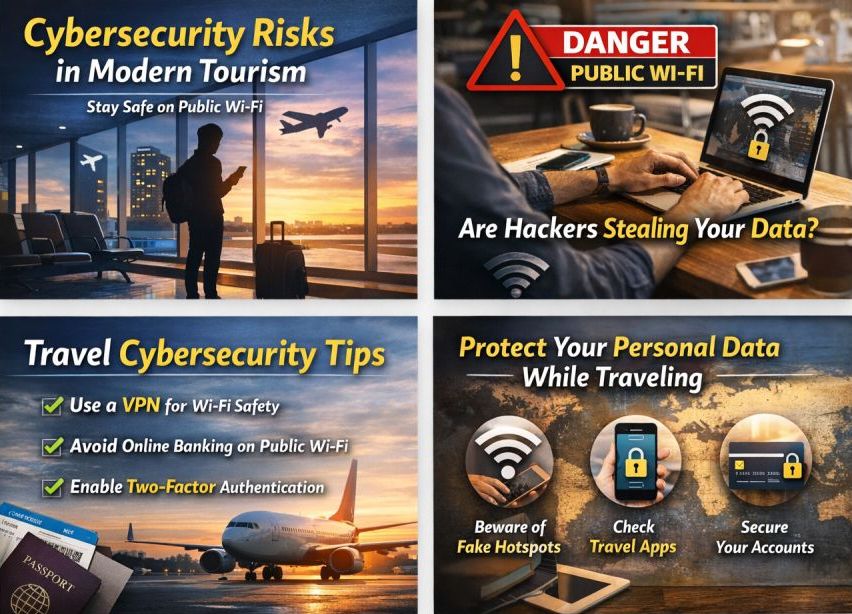
The good news is that protecting yourself while travelling is not hard. Just a few simple steps can lower your risks.
1. Avoid Sensitive Transactions on Public Wi-Fi
Do not perform activities such as:
- Online banking
- Credit card payments
- Logging into work accounts
when connected to public Wi-Fi.
If possible, use mobile data instead.
2. Use a VPN
A Virtual Private Network (VPN) scrambles your internet traffic, making it much harder for hackers to steal your data.
Security experts suggest using a VPN when connecting to an airport or hotel Wi-Fi.
3. Verify Wi-Fi Networks
Before connecting to a network:
- Ask staff for the correct Wi-Fi name
- Stay away from networks with names that seem suspicious
- Turn off automatic Wi-Fi connections
4. Enabling Two-Factor Authentication
Two-factor authentication (2FA) is essential as it adds an extra security layer.
In cases, if someone steals your password, they still can’t get into your account without the second step.
5. Keep Devices Updated
Old software often has security holes.
Before travelling, update:
- Phone operating system
- Apps
- Antivirus software
6. Be Careful with Travel Apps
Download apps only from official stores and check reviews before installing.
If an app asks for permissions it doesn’t really need, it might be dangerous.
7. Limit Social Media Sharing
Posting real-time updates like “Leaving for vacation!” can let criminals know you’re not at home.
It can also show your location to cybercriminals.
The Role of the Tourism Industry
Cybersecurity is not just the responsibility of travellers.
Tourism businesses must also improve their digital security practices.
Research shows that many tourism companies still lack robust cybersecurity systems. Some businesses skip regular security checks or staff training.
Hotels, airlines, and travel platforms must invest in:
- Secure Wi-Fi networks
- Data encryption
- Employee cybersecurity training
- Strong privacy policies
Creating secure digital systems will help keep both businesses and travellers safe.
The Future of Cybersecurity in Tourism
As technology continues to evolve, tourism will become even more connected.
Smart hotels, biometric boarding, and AI travel assistants will bring new opportunities, but also new risks.
Experts say that protecting digital travel experiences will soon be just as important as physical security at airports.
Travellers need to learn basic online safety, and the tourism industry should treat cybersecurity as a key part of keeping customers safe.
Final Thoughts
Modern tourism is convenient thanks to digital systems, but it also exposes travellers to cybersecurity threats.
Public Wi-Fi, fake apps, phishing scams, and weak travel platforms can turn a dream vacation into a financial nightmare.
The good news is that most cyber risks can be avoided with awareness and smart habits.
Before your next trip, take action: Protect your passport, secure your luggage—and actively safeguard your data with smart online habits and awareness at every step.
In today’s connected world, cybersecurity is essential for safe travel.