In today’s digital finance ecosystem, cybersecurity is not just a technical concern. It is a core economic factor that shapes profitability, trust, and organizational survival. As digital transactions become widespread and financial services reach all aspects of life, cybersecurity economics has become central to strategic planning.
From AI-enabled fraud to the looming quantum threat on blockchain security, this blog explores the measurable financial impacts, investment strategies, and future-proofing mechanisms that can help financial institutions and digital innovators not just survive, but thrive.
The Economic Landscape of Cybersecurity in Finance
A Multi-Trillion Dollar Problem
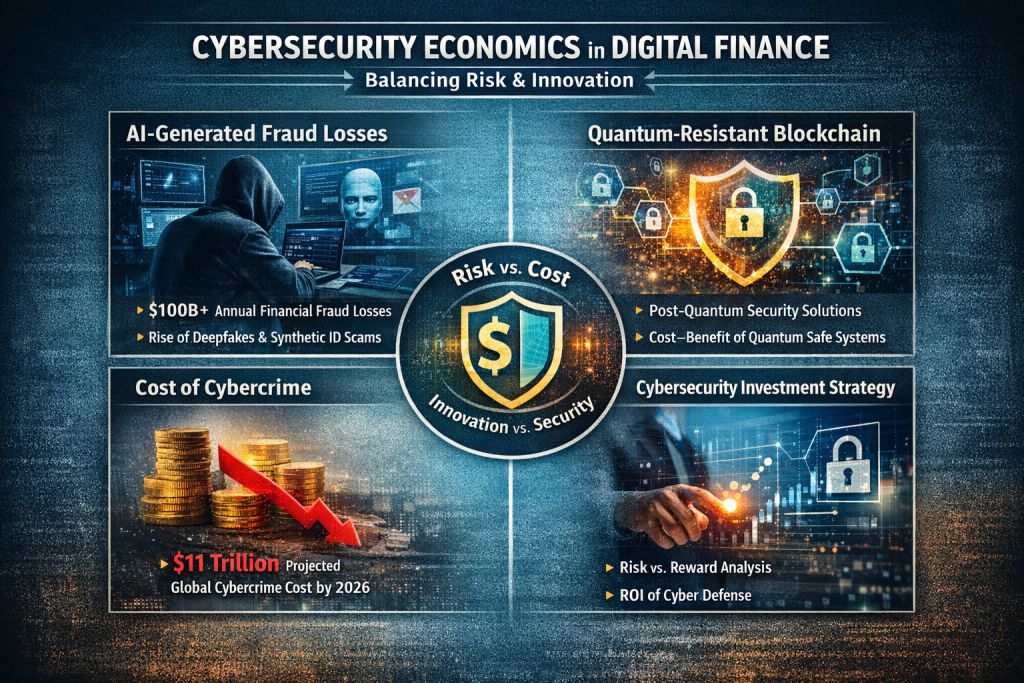
Cybercrime is not only a technical issue; it is a significant economic challenge. Recent projections estimate global cybercrime costs will reach nearly $11 trillion annually by 2026, including stolen funds, lost productivity, legal costs, reputational harm, and operational disruption.
For financial institutions, the stakes are uniquely high:
- Cybercriminals target the vast liquidity and sensitive data inherent in financial systems.
- The industry faces more AI-powered cyberattacks than any other sector. Approximately 45% of financial services firms experienced AI-enabled attacks in the past year.
This shift places cybersecurity economics firmly within business risk management, rather than limiting it to IT operations.
Why Cybersecurity Is a Core Financial Decision
Cost of Breaches vs. Cost of Protection
The economic calculus of cybersecurity pivots on a simple truth:
- The cost of breaches often exceeds the cost of prevention, provided that investments are strategic and well-planned.
Economists use models such as the Gordon–Loeb model, which suggests organizations should invest in cybersecurity up to a point, typically not exceeding 37% of expected breach losses, to optimize risk mitigation without overspending.
This model crystallizes a core insight of cybersecurity economics:
- Security investments should be data-driven and proportional to quantifiable risk, rather than reactionary or based on fear.
Measuring Financial Losses from AI-Generated Fraud
The rise of AI enhances both defensive capabilities and the sophistication of fraudulent activities.
What the Data Says
- Organizations increasingly report AI-assisted cyberattacks, such as deepfakes, phishing, and automated scamming.
- AI-generated identity fraud, synthetic profiles, and automated scams are driving unprecedented volume and speed in fraudulent transactions.
Traditional loss estimates from global finance and crypto fraud already ring in billions annually:
- Blockchain crypto fraud alone resulted in roughly $5.6 billion in losses globally, with broader financial fraud (including identity theft & counterfeit checks) expected to exceed $100 billion.
- Industry estimates indicate that crypto cybercrime accounted for over 57% of finance-related cybercrime losses in 2025.
The Hidden Costs
Financial losses from AI-generated fraud extend beyond direct theft:
- Operational disruption as systems go offline or are investigated.
- Reputational damage, especially as trust is critical for customer retention.
- Regulatory penalties for violating cybersecurity compliance.
In advising fintech startups, I have observed that smaller platforms often lose capital due to cascading effects such as customer withdrawal, increased insurance premiums, and legal defense fees. This demonstrates that loss accounting should include secondary economic impacts.
Cost–Benefit Analysis of Quantum-Resistant Blockchain Systems
Understanding the Quantum Shift
Quantum computing offers significant computational power but also threatens to compromise current cryptographic foundations such as RSA and ECC, which support most blockchain and digital security systems.
Therefore, quantum-resistant blockchain systems are not just a future consideration; they are economic necessities.
Weighing Costs vs. Benefits
Costs:
- Research and development of post-quantum cryptographic algorithms like lattice-based protocols.
- Integration and scaling in existing blockchain infrastructure.
- Talent acquisition, as quantum expertise commands high premiums.
Industry surveys highlight key hurdles:
- Quantum security deployment can cost approximately $10 to $15 million per institution.
- A majority of banks cite scalability and regulatory uncertainty as barriers.
Benefits:
- Significant reduction in breach costs, as quantum cryptography can substantially reduce fraud damages.
- Elevated trust and regulatory alignment.
- Long-term viability in a rapidly evolving threat landscape, particularly as quantum attacks become more feasible.
A 2025 study on quantum-resistant blockchain frameworks showed 96% accuracy in fraud detection and reduced computational overhead by 35%, demonstrating economic value beyond just risk avoidance.
Real-World ROI Considerations
For many financial institutions, the choice comes down to:
- Investing early in resilience helps avoid significantly higher costs later.
- A stepwise approach, such as building MVP quantum-secure features, testing performance, and scaling based on measured ROI, is often more financially prudent than a complete transition at once.
Strategic Cybersecurity Investment: Practical Best Practices
To make cybersecurity economics work in digital finance, organizations should:
- Adopt Predictive AI for Defense
AI is not only a threat vector; it also serves as a cost-effective defense.
Studies highlight AI-powered detection that reduces false positives by up to ~62% while maintaining high accuracy.
- Build Cost-Sensitive Security Architectures
Deploy layered cybersecurity, ranging from Zero Trust to blockchain verification, that scales with risk exposure.
- Quantify Risk to Measure Impact
Use hybrid economic models, such as variants of the Gordon–Loeb model, to budget strategically.
- Invest in Talent & Continuous Training
Human oversight is essential, as AI systems without skilled supervision can introduce unforeseen market volatility or bias.
- Engage with Regulatory Compliance Early
As regulatory landscapes evolve, proactive engagement helps reduce compliance costs and minimize penalties.
Final Thoughts: Economics Doesn’t Lie
Cybersecurity is integral to digital finance economics.
A breach is not a matter of if, but when, and preparation is critical. As AI and quantum technologies reshape threats and defenses, the cost of inaction is not limited to breaches but includes broader strategic setbacks.
Whether measuring AI-generated fraud losses or evaluating quantum-resistant systems, the economic imperative is clear: invest strategically, not just more.
Your competitive advantage lies not only in technology but also in economic resilience.