A Deep Dive Into V2X Vulnerabilities, Navigation Spoofing, and Algorithmic Attacks
Autonomous vehicles (AVs) are reshaping urban mobility, connecting through vehicle-to-everything (V2X) systems for greater safety and efficiency. However, these innovations create a new digital battlefield: as connectivity improves, the risk of cyberattacks on vehicles and infrastructure grows significantly.
Modern vehicles are advanced mobile computers, expanding the attack surface for cyber threats targeting networks, sensors, navigation systems, and algorithms. This article highlights how growing connectivity heightens risks—focusing on manipulation, spoofing, and interference that could ultimately jeopardise automated mobility and safety.
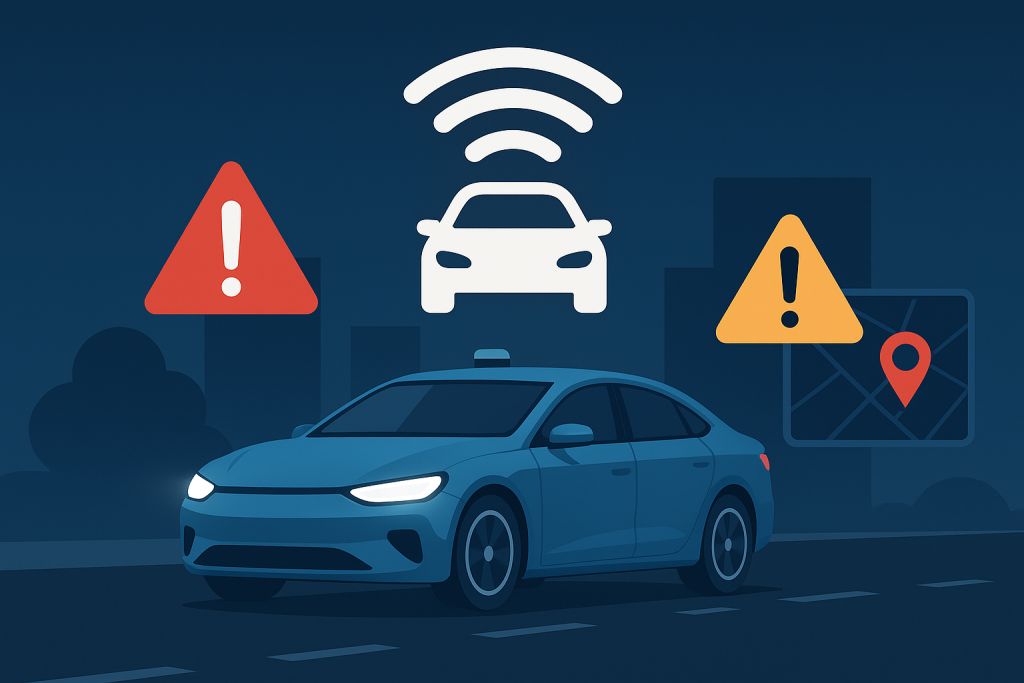
The Digital Backbone of Autonomous Mobility: V2X Communication
To operate safely, autonomous vehicles must continuously communicate with:
- Other vehicles (vehicle-to-vehicle or V2V)
- Roadside infrastructure (vehicle-to-infrastructure or V2I)
- Pedestrians and devices (vehicle-to-pedestrian or V2P)
- Cloud platforms (vehicle-to-cloud or V2C)
- The broader network ecosystem (vehicle-to-everything or V2X)
This communication occurs via protocols such as Dedicated Short-Range Communications (DSRC), Cellular Vehicle-to-Everything (C-V2X), fifth-generation mobile networks (5G), and edge computing platforms.
However, a significant challenge remains:
Any system connected to a network is exposed to risks of attack, manipulation, spoofing, or interception.
1. V2X Communication Vulnerabilities: When Digital Traffic Signals Lie
V2X communication systems rely heavily on wireless signals, which allows attackers to intercept, alter, or generate fraudulent messages.
Potential Cyber Threats in V2X Networks
a) Fake Traffic Messages (Message Injection Attacks)
For example, an attacker could send a false message such as:
- “Emergency braking ahead”
- “Road closed, rerouting required”
- “Pedestrian crossing detected”
An autonomous vehicle receiving such fabricated data may abruptly brake or reroute, potentially causing collisions or traffic congestion.
b) Denial of Service (DoS) on V2X Networks
A targeted attack could overwhelm a vehicle’s communication network, preventing it from receiving critical data such as signal changes or collision warnings.
This threat escalates in scenarios such as:
- Busy intersections
- High-speed expressways
- Smart city traffic ecosystems
c) Man-in-the-Middle Attacks on V2X Channels
Building further, attackers may intercept or alter communications between vehicles and infrastructure, injecting malicious data or even blocking critical safety signals.
A Firsthand Experience That Shifted My Perspective
At a smart mobility demonstration in 2023, I observed an autonomous shuttle abruptly reroute without an apparent reason. The team later explained that a testing device had inadvertently broadcast a high-priority V2X message, prompting the shuttle to respond defensively.
Although this was not a malicious attack, it revealed a critical vulnerability:
A single incorrect message can override the vehicle’s decision-making process.
This incident underscored the importance of authenticating and validating every machine-to-machine (M2M) communication within V2X environments.
2. Navigation Spoofing: When GPS Lies, Vehicles Lose Their Way
Autonomous vehicles use multiple technologies for location awareness, including the Global Positioning System (GPS), Inertial Measurement Units (IMUs), Light Detection and Ranging (LiDAR), radar, and cameras. However, GPS remains among the most vulnerable components.
GPS Spoofing: A Low-Cost, High-Impact Attack
Attackers can use inexpensive radio equipment to broadcast false GPS signals.
When a vehicle receives spoofed coordinates, it may:
- Think it’s in a different location
- Take alternate routes
- Miscalculate distances
- Slow down or speed up unexpectedly
Real-World Example: The Shanghai “Walking Ships” Phenomenon
Ships near Shanghai exhibited unusual GPS patterns, later found to result from large-scale GPS spoofing. If similar attacks targeted autonomous vehicles, the consequences could be severe.
A Hypothetical Scenario Illustrating the Risk
Consider the following scenario:
A self-driving car travelling on a highway receives a spoofed GPS signal that places it 200 meters to the left of its actual location.
Its AI system may attempt to reposition by changing lanes or slowing abruptly, potentially causing a serious multi-vehicle accident.
Though hypothetical, this scenario is feasible with current spoofing tools. Its plausibility has deeply influenced my view of AV cybersecurity.
3. Cyber threats also extend to the vehicle’s brain: attacks on autonomous driving algorithms.
Autonomous vehicles rely on AI for perception, decision-making, and control. However, AI algorithms remain vulnerable to manipulation.
a) Adversarial Attacks on Vision Systems
Researchers have demonstrated that small stickers placed on stop signs can cause AI systems to misinterpret them as:
- Speed limit signs
- Yield signs
- Non-sign objects
If a visually altered sign is introduced, a self-driving vehicle could:
- Ignore a stop
- Speed through intersections
- Misread road symbols
b) Sensor Fusion Manipulation
AVs integrate data from multiple sensors, including LiDAR, radar, and cameras.
Attackers could:
- Blind sensors with lasers
- Jam radar with RF interference
- Feed corrupted data to cameras using projected imagery
These actions can confuse the algorithm, leading to poor decisions.
c) Algorithmic Bias Exploitation
Different autonomous driving systems respond differently to environmental conditions. Attackers can exploit predictable behaviours such as:
- Hesitation at roundabouts
- Sudden braking when encountering unusual objects
- Lane drift under low visibility
This predictability, if left unaddressed, leaves systems open to repeated exploitation.
4. Cloud and Backend Vulnerabilities: The Attack Surface You Don’t See
Autonomous vehicles rely heavily on:
- Over-the-air (OTA) updates
- Cloud-based digital maps
- Real-time traffic analytics
- Centralised AI models
These introduce backend vulnerabilities, including:
- Exploitation of application programming interfaces (APIs)
- Breaches of cloud databases
- Manipulation of over-the-air (OTA) updates
- Remote takeover attempts
Unauthorised extraction (exfiltration) of driving logs, routes, and usage habits
If compromised, an OTA update could affect thousands of vehicles simultaneously, mirroring the rapid spread of malware across connected devices.
5. Real-World Cyber Incidents That Prove the Threat Is Real
- Jeep Cherokee Hack (2015)
- White-hat hackers remotely disabled the vehicle’s transmission and brakes.
- Tesla Model X Bluetooth Hack
- Researchers hacked the keyless entry system using BLE vulnerabilities.
- BMW ConnectedDrive Attack
- Exposed cars to remote door unlock and engine manipulation.
These ethical demonstrations serve as reminders that every smart mobility system remains a potential attack surface.
6. What Makes Autonomous Vehicles So Attractive to Hackers?
- High Value Targets
- Autonomous vehicles are valuable assets, making them attractive targets for ransom or theft.
- Human Safety Impact
- Unlike phones or laptops, compromised AVs can result in physical harm.
- Data Goldmine
AVs store:
- Camera footage
- Route history
- Personal profiles
- Biometric access
- Cloud-linked information
- Nation-State Interest
As AVs become integrated into smart city infrastructure, they form part of the national critical infrastructure.
7. Securing autonomous vehicles is essential.
Key priorities include:
a) Encrypted V2X Communication
Using PKI-based authentication to validate messages.
b) Anti-Spoofing Navigation Systems
Integrating GPS with IMU and LiDAR mapping.
c) AI Robustness Training
Training algorithms against adversarial examples.
d) Secure OTA Update Mechanisms
Hardware-backed encryption and signature validation.
e) Network Intrusion Detection in Vehicles
This includes real-time detection of unusual activity and security threats in in-vehicle communication networks, such as Controller Area Network (CAN) and Ethernet systems.
f) Regulatory and Testing Standards
ISO/SAE 21434 and UL 4600 are emerging frameworks for automotive cybersecurity. ISO/SAE 21434 is an international automotive cybersecurity standard, while UL 4600 guides safety for autonomous products.
Final Thoughts: A New Era of Cyber-Aware Mobility
Autonomous vehicles promise safer, more efficient travel, but also open the door to new cyber risks. As V2X, navigation, and AI technologies multiply, their vulnerabilities could turn the road network into a target for digital threat actors, making cybersecurity the defining challenge for future mobility.
While writing this blog, the moments I’ve witnessed—like the autonomous shuttle reacting to unintended V2X signals—reminded me that even well-designed systems can be misled. Cybersecurity is no longer an option; it’s a necessity.
The future of smart mobility will depend on our ability to proactively secure every link in the digital chain—from vehicles to cloud infrastructure. Prioritising cybersecurity is essential to ensure these advancements deliver on their promise without compromising safety or trust.