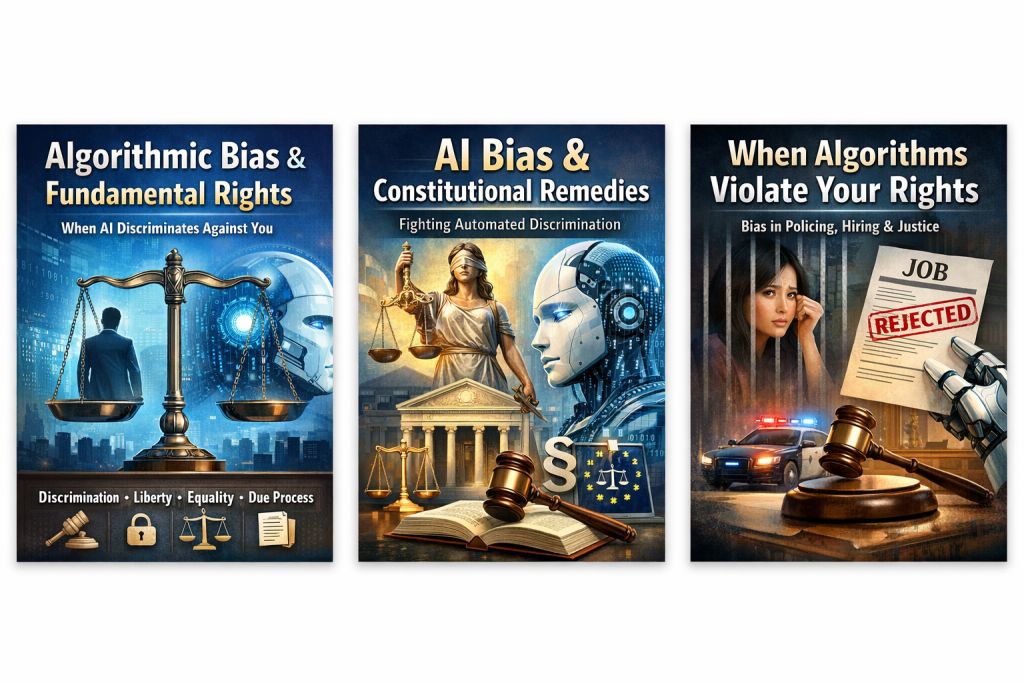
Algorithms now determine access to loans, employment, policing, and bail. When these systems inherit or amplify social bias, the consequences extend beyond technical flaws and become violations of fundamental rights. This post explains why algorithmic bias is a rights issue, provides examples of discrimination by automated systems, and outlines necessary constitutional and policy remedies.
Why algorithmic bias is a rights problem, not just a tech problem
Automated decisions may appear neutral, as models generate scores based on data. However, these algorithms are trained on historical and administrative data that reflect longstanding inequalities. When used in areas affecting liberty, livelihood, dignity, or equal treatment, such models are subject to constitutional and human rights protections.
Criminal-risk assessment tools used in courts have been shown to produce different error rates for Black and white defendants, with Black defendants more often incorrectly labeled as “high risk.” This is not a minor technical issue; it leads to longer sentences, stricter supervision, and limited access to rehabilitation. The ProPublica analysis of COMPAS brought this issue to public attention and initiated global debate.
Real-world patterns of automated discrimination
Automated systems produce discrimination in many ways:
- Direct proxying: A model may use variables (e.g., address, employment gaps) that proxy for protected traits such as race, caste, gender, or religion.
- Training-data bias: Historical patterns of discrimination (over-policing, hiring biases) produce skewed labels that models learn and amplify.
- Unequal error rates: Even models with the same average accuracy can have wildly different false-positive/false-negative rates across groups — meaning unequal harms.
- Black-box opacity: Proprietary or complex models make it impossible for affected people to understand, challenge, or correct decisions about them.
Courts have already wrestled with these harms. In State v. Loomis, the Wisconsin Supreme Court considered whether the use of a closed-source risk score in sentencing violated due process; it required cautionary instructions but declined to bar the tool, highlighting the tension between algorithmic opacity and procedural fairness.
When fundamental rights are at stake: examples by right
- Right to equality / non-discrimination: Decisions that disproportionately exclude or penalize protected groups can violate equal-protection principles (or equivalent constitutional guarantees).
- Right to life, liberty, dignity: Automated decisions that affect detention, bail, or essential services implicate the right to life and liberty (or their domestic constitutional analogues).
- Right to privacy / informational autonomy: Profiling and opaque data-driven inferences undermine informational autonomy — a right increasingly recognized by courts worldwide. (See the Indian Supreme Court’s expansive recognition of privacy in K.S. Puttaswamy.)
Constitutional and statutory remedies: what works (and what doesn’t)
No single solution exists. Effective redress requires a comprehensive approach involving courts, regulation, technical audits, and public participation.
1. Due process & procedural safeguards
Where automated decisions produce legal effects (sentencing, welfare eligibility, immigration), courts should require:
- Meaningful notice that an algorithm was used;
- The underlying logic or a testable explanation (subject to trade-secret safeguards);
- The right to challenge scores with expert evidence;
- Human oversight that can override algorithmic outputs when legally required.
Loomis demonstrates that courts recognize these issues but often hesitate to implement strong remedies. This reluctance must be addressed when fundamental rights are at stake.
2. Non-discrimination law and constitutional claims
Equality claims under constitutions and statutes remain effective. Plaintiffs may demonstrate disparate impact, where neutral practices have disproportionate effects, or intentional discrimination based on evidence of biased design or use. Courts should adapt existing doctrines, such as disparate-impact analysis, to algorithmic contexts and acknowledge when opaque models hinder fair adjudication.
3. Data-protection and informational rights
Europe’s GDPR already limits automated, legally significant decisions and requires transparency mechanisms — the “right not to be subject to solely automated decisions” and information obligations for data subjects. These legal levers give individuals a basis to demand explanations, human review, or opt-outs.
4. Regulatory frameworks and risk-based rules
Regulatory action, rather than aspirational statements, is essential. The EU’s AI Act, a risk-based statute imposing stricter requirements on high-risk systems such as those in criminal justice, hiring, credit, and essential services, serves as a model for enforceable rules that prevent harm. Laws should mandate impact assessments, audits, data documentation, and penalties for violations.
5. Algorithmic impact assessments & independent audits
Operational safeguards such as Algorithmic Impact Assessments (AIAs), standardized testing for disparate impacts, and third-party audits should be required for systems affecting fundamental rights. The AIA framework, supported by researchers and governments, establishes a pre-deployment accountability process that translates constitutional principles into practical procedures. (See the academic and policy literature advocating AIAs.)
What meaningful remedies look like — concrete steps for reform
1. Prohibit or strictly limit algorithms that significantly affect liberty, such as facial recognition in public policing, until robust safeguards are in place.
2. Require transparency for public-sector and high-risk private algorithms, including documentation of training data, fairness metrics, and governance practices.
3. Guarantee the right to explanation and effective appeal, providing enforceable means for individuals to understand, contest, and correct decisions.
4. Mandate independent, regular audits with public summaries to identify model drift and emerging bias.
5. Provide statutory damages and injunctive relief to ensure victims can obtain meaningful remedies and halt harmful deployments.
6. Involve affected communities in the design, testing, and governance of algorithms to identify context-specific risks early.
The White House’s “Blueprint for an AI Bill of Rights” outlines principles aligned with these reforms. However, critics note that nonbinding guidance is insufficient without enforcement. Creating binding legal obligations is the necessary next step.
A practical vignette (why this matters)
Consider a job applicant repeatedly denied due to an automated screening system that down-ranks résumés from certain areas or penalizes employment gaps related to caregiving, which disproportionately affects women. While the system may appear efficient, it perpetuates disadvantage, reinforces inequality, and undermines economic dignity—a clear rights violation presented as automation. Public interest litigation combining anti-discrimination law with transparency requirements can compel disclosure, redesign, and compensation.
Final point: technology can help or harm — the choice is legal and political
Addressing algorithmic bias requires more than improved code; it demands legal, regulatory, and civic action. Courts should treat biased automated systems as constitutional issues when they affect equality, liberty, or dignity. Regulators must convert principles into enforceable rules, including impact assessments, audits, and disclosure obligations. Companies should prioritize equity in development and governance. Civil society must continue to document harms and translate technical findings into legal claims.
If you are concerned about fairness—as a lawyer, policymaker, engineer, or affected citizen—begin by asking whether an automated decision affects a fundamental right. If so, demand transparency, independent audits, human review, and enforceable remedies. Technology will advance justice only if law, policy, and public engagement guide its impact.