Introduction: A New Age of History Begins
For centuries, history has relied on preserved fragments such as faded manuscripts, damaged monuments, broken pottery, oral stories, and fragile paintings. Historians constructed narratives through careful analysis and interpretation. Now, artificial intelligence is becoming an essential tool for historians, fundamentally transforming how history is analyzed and reconstructed.
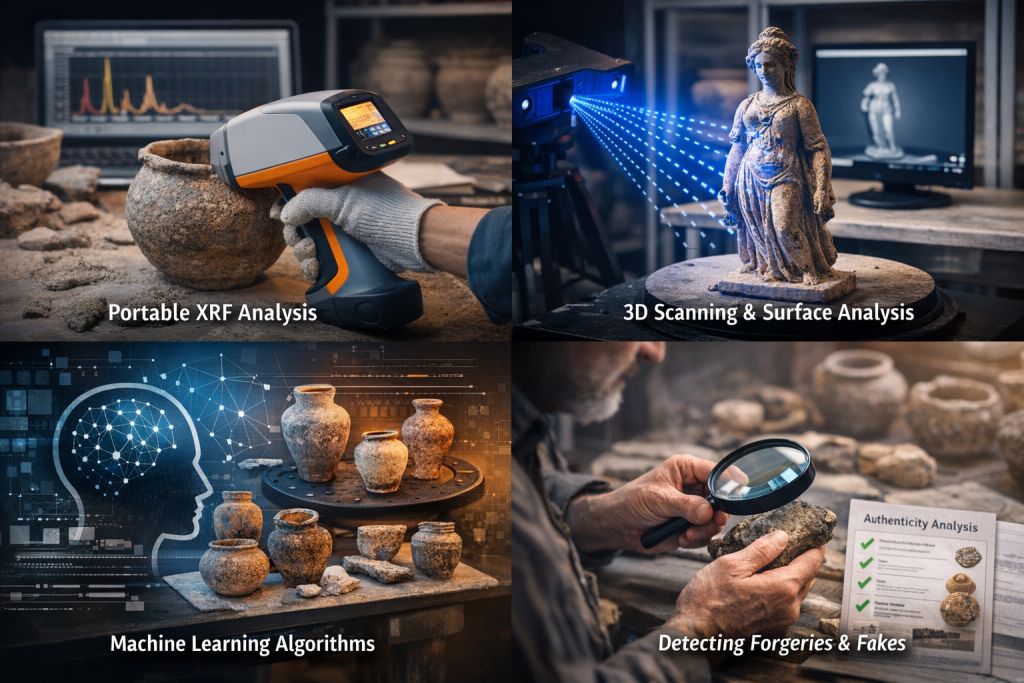
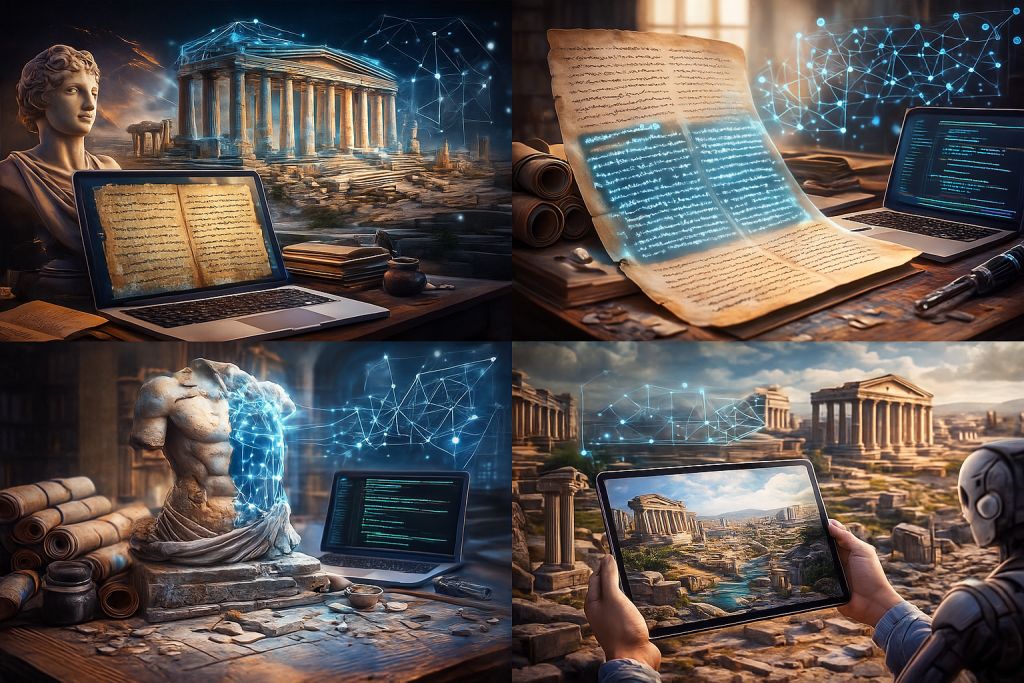
AI-assisted historical reconstruction, using machine learning, computer vision, natural language processing, and predictive modeling, is uncovering lost histories, restoring ancient artifacts, and reconstructing previously ambiguous events. Tasks that once took years can now be completed with greater speed and accuracy.
The aim is to enhance historians’ capabilities, not replace them.
While testing an AI model for restoring historical manuscripts, I saw it reconstruct missing Sanskrit characters from a 12th-century text that had stumped historians for decades. Though not flawless, it showed the powerful shift technology brings to historiography.
This blog examines how AI is changing the methods of writing, reconstructing, and interpreting history, and considers how future historians may combine scholarly and technological expertise. Each major domain—texts, artifacts, events, sites, and analysis—experiences distinct changes as AI becomes integral to research, as detailed in the following sections.
What Is AI-Assisted Historical Reconstruction?
AI-assisted historical reconstruction refers to the application of machine learning, deep learning, and computational modeling to:
- Restore lost or damaged historical texts
- Rebuild physical artifacts or architecture from fragments
- Reconstruct historical events and timelines
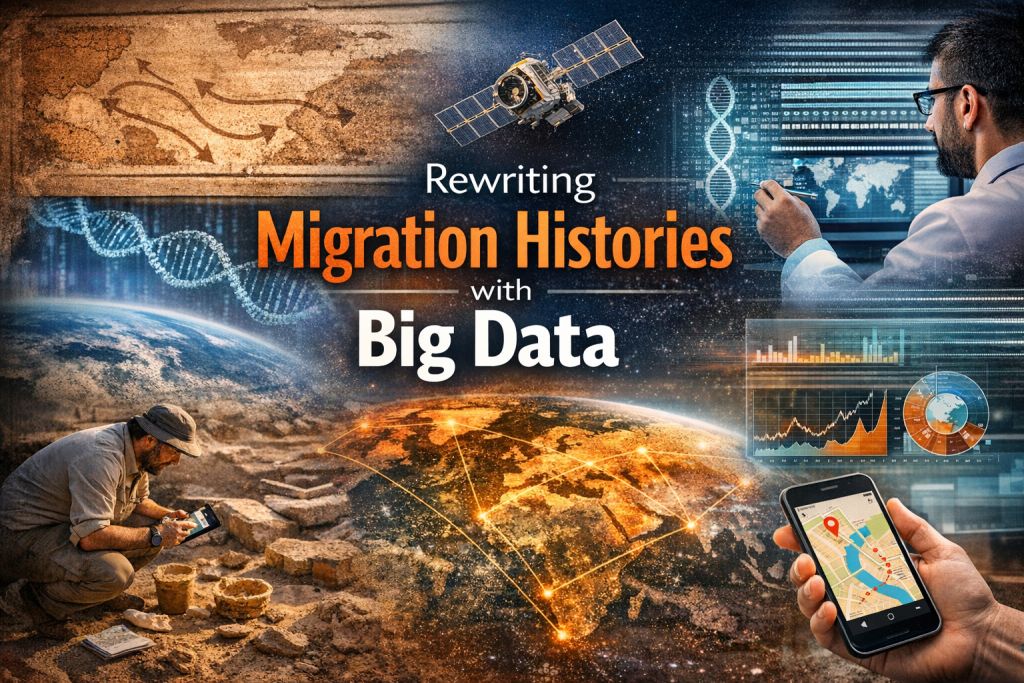
- Predict cultural patterns or migrations
- Decode undeciphered scripts
- Analyze large datasets from archives, archaeology, and museums
This field exists at the intersection of digital humanities, archaeology, computer science, and cultural heritage preservation.
Machine learning tools—especially deep neural networks—are uniquely suited to historical research because they can:
- Process massive datasets
- Identify hidden patterns
- Recognize visual and textual features
- Predict missing information
- Generate plausible reconstructions
As a result, AI is not only assisting historians but also redefining historiography.
1. Reconstructing Lost Manuscripts and Scripts with NLP
Historical reconstruction through natural language processing (NLP) represents a significant advancement.
Today, AI can:
- Digitize old manuscripts
- Reconstruct missing words or pages
- Translate ancient languages
- Identify authorship and stylistic patterns
- Restore ink faded beyond human readability
A notable example is the “Vesuvius Challenge,” in which AI models successfully read carbonized scrolls from Herculaneum that had been unreadable for nearly 2,000 years.
Personal reflection
Working with an AI model, I uploaded a damaged Bengali palm-leaf manuscript page, expecting little.
Within seconds, the AI filled gaps accurately. It felt as if history came alive.
This confirmed AI’s unique role in preserving our literary heritage.
2. AI and Archaeology: Rebuilding Civilizations from Fragments
Archaeology is often described as the study of fragments. AI is enabling the reconstruction of these fragments into complete narratives.
Machine learning can now:
- Analyze shards of pottery and predict full vessel shapes
- Reconstruct broken statues or sculptures
- Identify architectural styles and missing structural components
- Map ancient trade routes
- Predict where undiscovered archaeological sites might be located.
Recently, researchers used AI to reconstruct the original appearance of the Parthenon sculptures and to digitally rebuild destroyed Syrian heritage sites using pre-war photographs and 3D modeling.
These advancements are especially significant for regions affected by conflict, climate change, or neglect.
3. Predicting Historical Events and Cultural Patterns
One of the most innovative applications of AI in historiography is predictive historical modeling.
Machine learning can analyze:
- Population data
- Economic patterns
- Agricultural productivity
- Migration flows
- Political systems
- Climate fluctuations
From these, AI generates models that help historians understand:
- Why civilizations collapsed
- How empires grew
- When societies experienced cultural shifts
- What environmental factors influenced historical events
This predictive capability does not rewrite history; instead, it adds depth and reveals new perspectives that were previously inaccessible.
For example, deep-learning climate models have helped historians uncover how monsoon failures contributed to the decline of the Indus Valley Civilization, giving us a richer understanding of ancient South Asian history.
4. Restoring Destroyed or Faded Historical Sites Through AI Vision
Computer vision enables historians and architects to reconstruct the past with remarkable realism.
AI can generate:
- 3D models of ancient cities
- Virtual reconstructions of destroyed architecture
- Digital restorations of paintings and murals
- Augmented reality experiences of historical spaces
A notable application involved using GANs (Generative Adversarial Networks) to reconstruct a damaged section of the Ajanta cave murals.
The AI-generated restoration not only filled in missing pigments but also predicted the artist’s style, color palette, and brushwork patterns.
This showed me that AI does more than replicate—it interprets history.
5. AI-Powered Historiography: The implications of these technical advancements extend further: they are changing the very discipline of historiography itself.
Traditional historiography relies heavily on interpretation, narrative, and human judgment.
AI introduces a new dimension: evidence-based pattern recognition.
Machine learning allows historians to:
- Validate theories through data
- Detect biases in traditional historical narratives
- Compare thousands of sources instantly
- Discover hidden correlations across cultures and timelines
For example, AI models have uncovered previously unnoticed trade connections between early African and South Asian coastal regions by analyzing patterns across thousands of nautical records and artifact databases.
Such insights are shifting historical writing from conjecture to data-backed interpretation.
6. Ethical Questions: As these innovations proliferate, historians and the public must consider ethical questions that arise from AI-augmented history.
The use of AI in historiography raises important ethical considerations:
- How do we prevent AI from reinforcing biases in historical datasets?
- Who decides what an ‘accurate’ reconstruction is?
- Should AI-generated history be considered equal to human interpretation?
- Can reconstructed artifacts influence cultural identity or political narratives?
These discussions are essential, as historical reconstructions influence national memory and global understanding.
Historians must use AI as a tool, not an authority.
7. The Future: Historians and AI Working Hand-in-Hand
Future historians will not be replaced by machines; instead, they will be empowered by them.
Tomorrow’s historiography will rely on:
- Interdisciplinary research
- AI-driven data analysis
- Digital reconstructions
- Predictive modeling
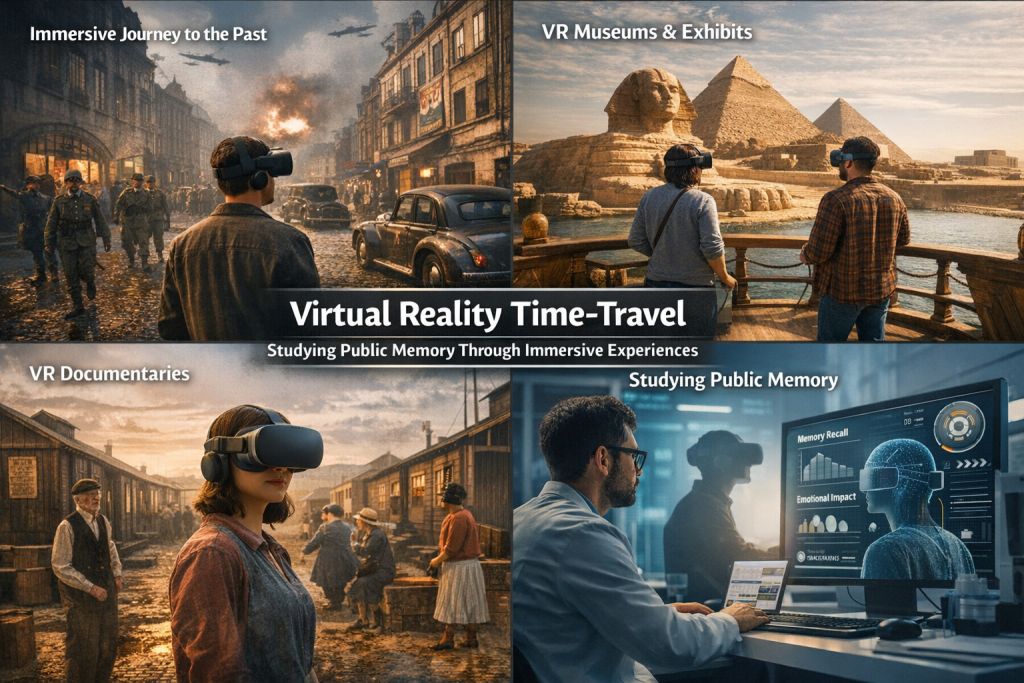
- Interactive virtual historical environments
Students may one day explore a fully reconstructed Mohenjo-Daro, read books featuring AI-generated visualizations of lost monuments, or see historians collaborate with AI to solve centuries-old mysteries.
We are entering an era in which history is immersive, dynamic, and data-rich.
Conclusion: AI Is Not Rewriting History—It Is Helping Us Recover It
AI-assisted historical reconstruction represents more than a technological trend; it is a cultural shift. It offers opportunities to:
- Recover lost knowledge
- Preserve endangered heritage
- Understand complex historical patterns
- Build richer narratives grounded in data
- Democratize access to historical material
While working with AI on old manuscripts, I came to a significant realization:
- We are the first generation with the ability to recover voices from the past through scientific methods rather than speculation.
- Machine learning is not redefining history; it is changing how we understand ourselves.
As long as historians, technologists, and cultural communities collaborate responsibly, AI will continue to reveal the past in new and meaningful ways.