For generations, farmers have used chemical fertilisers to boost crop yields. These products helped agriculture expand rapidly, particularly during the Green Revolution.
Over time, however, farmers noticed troubling changes in the soil.
Land that once responded efficiently to fertilisers gradually lost productivity. Farmers had to apply more each year to achieve yields similar to those of previous years. In some regions, soils became compacted, arid, and less fertile.
This issue has prompted scientists and agricultural experts to investigate more sustainable alternatives. The use of bio-fertilisers and microbial soil enhancers is emerging as a recognised solution worldwide.
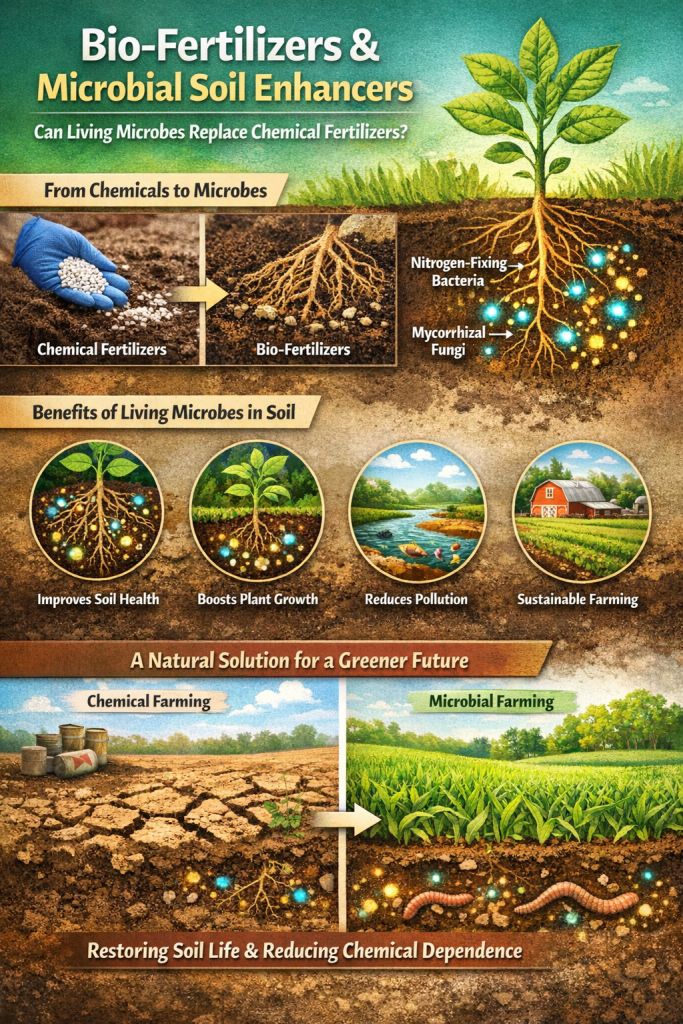
Rather than relying solely on chemical inputs, this method uses living microorganisms to boost soil health and plant growth.
What Exactly Are Bio-Fertilisers?
Bio-fertilisers are natural products that contain beneficial microorganisms. These microscopic organisms live in the soil and interact closely with plant roots.
Unlike chemical fertilisers that supply nutrients directly to crops, bio-fertilisers help plants access nutrients already present in the soil.
In healthy soil, millions or even billions of microbes are constantly at work. They break down organic matter, release nutrients, and create conditions that promote plant growth.
Bio-fertilisers enhance these natural processes by introducing beneficial microorganisms, including:
- Nitrogen-fixing bacteria
- Phosphate-solubilising bacteria
- Mycorrhizal fungi
- Cyanobacteria used in rice cultivation
Each microbial group fulfils a distinct function in maintaining soil fertility and supporting plant development.
The Downside of Heavy Chemical Fertiliser Use
Chemical fertilisers played a critical role in boosting food production worldwide. There is no doubt about their historical importance.
However, excessive and prolonged use of chemical fertilisers can result in several adverse effects.
Soil Quality Can Decline
Continuous application of chemical fertilisers can diminish soil organic matter. As organic content declines, soil structure deteriorates, and microbial activity decreases.
Nutrient Runoff Can Harm Water Bodies
Rainfall can transport unused fertilisers from fields into rivers and lakes, leading to nutrient enrichment and algal blooms that harm aquatic ecosystems.
Costs Continue to Rise
Fertilisers are a significant expense for many farmers. Price volatility can cause financial strain, especially for small-scale producers.
Soil Life May Be Disrupted
Healthy soils have diverse biological activity. Excess chemicals disrupt this balance.
Given these challenges, a growing number of agricultural researchers are now emphasising the restoration of soil biological health.
Replacing Chemical Fertilisers With Living Microbes
A key development in sustainable agriculture is using living microbes to replace or reduce reliance on chemical fertilizers.
Although this concept may appear novel, it reflects natural nutrient cycling processes that have always existed in ecosystems.
Before modern fertilisers existed, plants depended on microorganisms to obtain nutrients. Certain bacteria capture atmospheric nitrogen and convert it into forms plants can absorb. Other microbes release phosphorus trapped inside soil minerals.
Certain beneficial microbes produce compounds that stimulate plant growth and enhance root development.
With enough beneficial microbes, these organisms become a natural support system for crops. Applying microbial enhancers restores the soil’s biological workforce.
How Microbial Soil Enhancers Help Plants
Beneficial microbes affect plant growth through several key mechanisms.
Making Nutrients Available
Many soil nutrients exist in forms unavailable to plants. Microorganisms facilitate the conversion of these nutrients into bioavailable forms.
Improving Soil Structure
Some microbes secrete substances that bind soil particles, improving aeration and water retention.
Supporting Root Development
Some bacteria synthesize phytohormones that promote the development of robust root systems.
Helping Plants Resist Disease
Healthy microbial communities can suppress harmful soil-borne pathogens.
Together, these processes often result in stronger plant growth and greater resilience to environmental stress.
A Story From the Field
A few years ago, I read about a farmer who decided to experiment with bio-fertilisers after attending a local agricultural workshop.
His land had been cultivated for decades, and he gradually increased his use of chemical fertiliser to maintain yields. Yet the soil became compact and difficult to manage.
Instead of changing everything at once, he began using microbial soil enhancers on just one section of his field.
The first season brought subtle changes. By the next year, the difference was clearer.
The soil became easier to till. Moisture stayed longer after irrigation. Earthworms, absent for years, began to appear again.
To him, this showed the soil was recovering.
Such examples show that improvements in soil biology take time, but the long-term benefits can be substantial.
Common Types of Bio-Fertilisers
A variety of microbial products are currently utilised in agricultural practices.
Nitrogen-Fixing Bacteria
These microorganisms fix atmospheric nitrogen and convert it into forms accessible to plants. They are commonly applied to legume and cereal crops.
Phosphate-Solubilising Microbes
Phosphorus is often trapped in soil minerals. Certain microbes secrete acids that release them for plants.
Mycorrhizal Fungi
These fungi form symbiotic associations with plant roots. Their hyphal networks help plants absorb more water and nutrients.
Cyanobacteria
Frequently utilised in rice cultivation, these organisms naturally augment nitrogen levels in flooded soils.
Each of these microbial groups contributes to improved soil health and enhanced crop productivity.
Environmental Benefits of Bio-Fertilisers
Bio-fertilisers provide multiple environmental benefits.
First, they reduce synthetic fertiliser use, lowering nutrient pollution in waters.
Second, they enhance long-term soil fertility by promoting natural biological activity.
Third, the production of microbial fertilisers typically requires less energy than the manufacture of chemical fertilisers.
Healthy soil ecosystems also support biodiversity, including insects and other organisms essential to agriculture.
Challenges Farmers Still Face
Despite their potential, bio-fertilisers have not achieved widespread adoption.
One barrier is limited awareness; many farmers are unfamiliar with how microbial products work and their benefits.
Another challenge is product consistency. As living organisms, microbes require proper storage and handling to maintain efficacy.
Bio-fertilisers may produce results more slowly than chemical fertilizers, which can discourage farmers seeking immediate improvements.
Research is making microbial technologies more reliable and user-friendly.
Simple Tips for Better Results
Farmers and gardeners interested in bio-fertilisers can enhance their success by following several practical recommendations.
Incorporating compost or organic matter fosters a supportive environment for beneficial microbes. Applying microbial products near plant roots facilitates rapid establishment.
Limiting excessive pesticide or fertiliser use also helps protect microbial communities.
Maintaining adequate soil moisture ensures ongoing microbial activity.
Looking Ahead
Soil microbiology is emerging as a prominent field within agricultural research.
Researchers study soil microbiomes to understand microbe-crop interactions. This may enable the development of customised microbial blends for specific soils and crops.
In the future, agricultural practices may increasingly integrate biological solutions with modern technological advancements.
Final Thoughts
Soil is more than a physical substrate; it is a living system populated by microorganisms that sustain plant life.
When this biological system is compromised, agricultural productivity declines. Restoring soil life with bio-fertilisers and microbial enhancers can gradually improve land productivity.
Although chemical fertilisers will likely continue to play a role in agriculture, growing interest in beneficial microbes signals a transition toward more balanced, sustainable farming practices.
The smallest organisms in nature may ultimately prove to be the most valuable contributors to global food production.
About the Author