A few years ago, I made a simple promise to myself: I would wake up at 5:30 AM and exercise every day.
The first week felt powerful with strong motivation and focus.
By week three, I was hitting the snooze button.
At the time, I blamed myself and thought I lacked discipline. But after studying behavioural science and observing patterns in myself and others, I realised something important:
- Sustainable health changes are not about willpower. They are about wiring.
Your brain is not designed to chase big goals. It is designed to conserve energy and repeat what feels rewarding. When you understand habit formation, healthy routines stop feeling like a battle.
Let’s break this down in a practical, real-world way to understand why habit change can feel so tough—and how your brain is wired to help you succeed.
Your Brain Runs on Automation
The human brain uses a lot of energy compared to the rest of the body. To save effort, it automates repeated behaviours. This is handled largely by a region called the basal ganglia.
When you first try something new, like going to the gym, your brain uses the prefrontal cortex. That’s the decision-making area. It is active, effortful, and prone to fatigue.
But when you repeat a behaviour enough times, control shifts. The action becomes automatic.
That’s why:
- You don’t think about locking your door.
- You check your phone without realising it.
- You crave snacks at a certain time every day.
These are neural shortcuts.
And here’s the good news: healthy habits can become shortcuts too.
The Habit Loop Explained Simply
Every habit follows a loop:
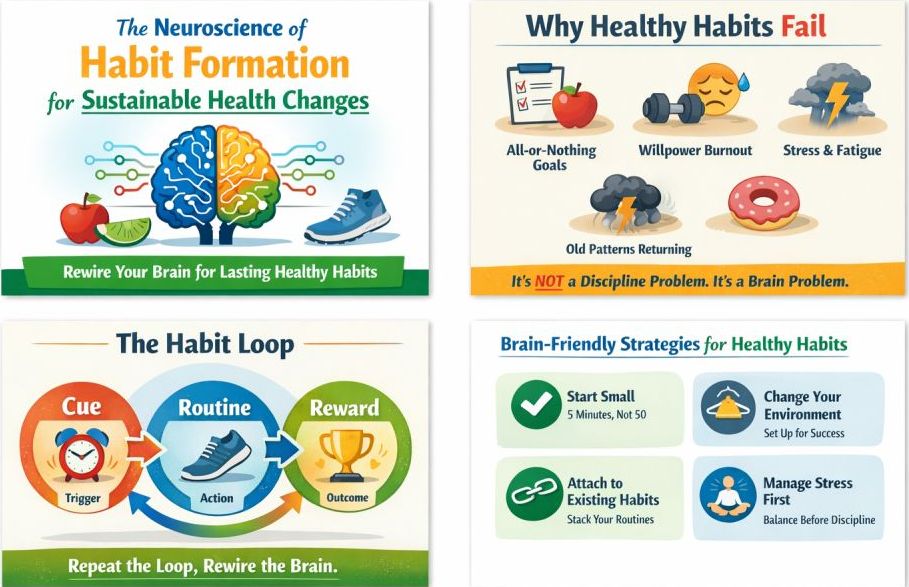
- Cue → Routine → Reward
For example:
- Cue: Afternoon slump
- Routine: Coffee or sugary snack
- Reward: Quick boost of energy
Over time, your brain associates the cue with the reward. It starts anticipating the reward the moment the cue appears.
Dopamine plays a big role here. Many people think dopamine is about pleasure. It is actually more about expectation. It rises when your brain predicts that something rewarding is about to happen.
That anticipation strengthens the loop.
This is why unhealthy habits feel so automatic. They deliver quick, predictable rewards.
Why Big Health Goals Backfire
One pattern I see repeatedly in myself and others is the “all-or-nothing” approach.
- Cut out all junk food. Work out every day. Sleep perfectly. Meditate 30 minutes daily.
- Work out every day.
- Sleep perfectly.
- Meditate 30 minutes daily.
For a short time, motivation carries you.
As stress rises, motivation fades, and the brain defaults to old patterns.
I remember trying to eliminate sugar entirely. For about ten days, I stayed strict. Then one stressful evening led to “just one dessert,” which turned into a full relapse.
Later, I tried something different. I replaced soda with sparkling water. That was it. Once that felt normal, I reduced desserts from daily to twice a week.
That slower shift worked. Why?
Because the brain adapts better to gradual change than to extreme disruption.
Neuroplasticity: The Brain Can Change at Any Age
One of the most encouraging findings in neuroscience is neuroplasticity—the brain’s ability to reorganise itself.
Every repeated action strengthens certain neural pathways. Think of it like walking through grass. The more you walk the path, the clearer it becomes.
Healthy lifestyle habits form in the same way.
At first, the action feels awkward. Then manageable. Eventually, automatic.
Habits stick in weeks or months—just keep repeating.
Five Practical, Brain-Friendly Strategies
After years of trial, error, and research, here are the strategies that create sustainable health changes.
1. Make the Habit Almost Too Easy
If you want to work out, start with five minutes.
If you want to read before bed, start with one page.
When a habit feels small and manageable, your brain is less likely to resist it. Starting with an easy version of the habit allows you to experience early success, which builds confidence and motivation. These small wins help you build momentum, eventually shaping how you see yourself and reinforcing the routine.
Consistency beats intensity.
2. Change Your Environment First
The environment often matters more than motivation.
When I struggled with evening workouts, I noticed something simple: my couch was inviting, and my workout gear was hidden.
I reversed it. I placed my shoes next to the door and set my workout clothes out the night before.
That small visual cue made action easier than avoiding it.
If healthy food is visible and junk food is not, your choices improve without mental strain.
Design reduces decision fatigue.
3. Attach New Habits to Existing Ones
You already have strong routines in place. Use them.
- After brushing your teeth, stretch.
- After making coffee, drink a glass of water.
- After shutting down your laptop, take a short walk.
Linking habits reduces the need for new reminders. The old behaviour becomes the trigger for the new one.
4. Focus on Who You’re Becoming
Instead of saying, “I need to lose weight,” say, “I’m becoming someone who takes care of my health.”
Identity-based habits last longer since they align with self-image.
When you believe you are a healthy person, actions begin to match that belief.
It shifts from “I have to” to “This is what I do.”
5. Manage Stress Before Expecting Discipline
Stress is one of the strongest disruptors of healthy routines.
When stress rises, your brain seeks comfort and familiarity. That’s when old habits return.
Practices like getting enough sleep, moving your body regularly, and using breathing exercises can help reduce stress and keep your emotions balanced. When you address stress directly, your brain is better equipped to stick to healthy routines, since high stress often triggers old, automatic behaviours.
Sometimes the most powerful habit is simply protecting your energy.
Why Sustainable Health Changes Feel Hard at First
New behaviours require conscious effort. Old habits run automatically.
In the early stage, the brain sees new routines as extra work. That discomfort is normal. It does not mean you are failing.
It means new neural connections are forming.
The key is not to aim for perfection. It is to avoid quitting.
If you miss a day, return the next day. Repetition matters most.
The Shift That Changed Everything for Me
The biggest breakthrough in my own journey wasn’t a new diet or workout plan.
It was understanding this:
- Healthy living is a system, not a mood.
When I stopped relying on motivation and reduced friction, habits became sustainable.
- I stopped aiming for long workouts and focused on showing up.
- I stopped extreme dieting and focused on small replacements.
- I stopped chasing perfection and focused on repetition.
Over time, those small adjustments reshaped my routines.
Now, many behaviours that once felt difficult feel automatic.
Final Thoughts
If you’ve struggled with building healthy lifestyle habits, you are not weak. You are human.
Your brain is wired to conserve energy and repeat what feels rewarding. When you work with that wiring rather than fight it, change becomes realistic.
Start smaller than you think you need to.
- Repeat consistently.
- Design your environment.
- Shift your identity.
- Protect your energy.
Sustainable health changes don’t happen in a burst of motivation. They are built quietly through repetition, patience, and smart design.
And once the wiring shifts, healthy choices stop feeling like effort.
They just become part of who you are.
About the Author