Introduction: From “Always Online” to Always Exhausted
A decade ago, being reachable at all times signaled progress. Today, it often creates pressure.
Many professionals, students, creators, and entrepreneurs report persistent fatigue, restless sleep, and ongoing low-grade anxiety, even on weekends. In my experience working late on digital projects, I noticed that even after closing my laptop, my mind remained active. The notifications stopped, but my nervous system did not.
At this point, digital detox is more than a wellness trend. It is a mental health and sleep optimization strategy supported by neuroscience, psychology, and behavioral science.
This guide goes beyond generic advice such as “use your phone less.” It provides practical digital detox strategies for those who cannot fully disconnect but still seek better sleep and reduced stress.
The Science Behind Digital Overload, Sleep, and Stress
1. Blue Light and Circadian Rhythm Disruption
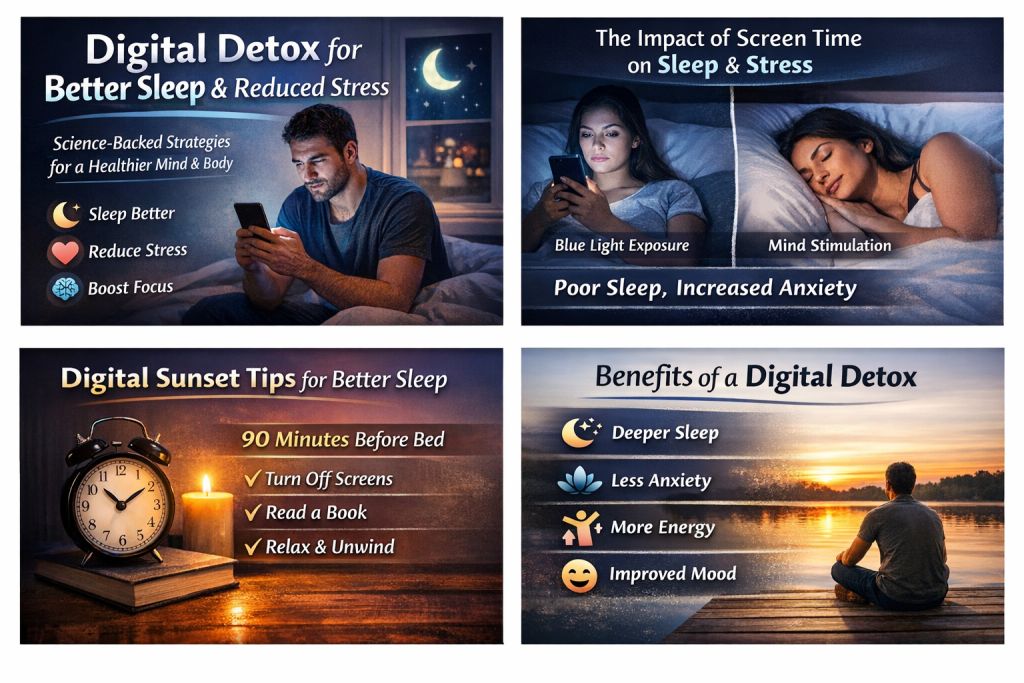
Research from Harvard Medical School shows that blue light emitted from screens suppresses melatonin production more than other light sources. Melatonin is the hormone responsible for signaling your brain that it’s time to sleep.
Even 30 to 60 minutes of screen exposure before bed can delay sleep onset.
Chronic suppression leads to shorter REM cycles and lighter sleep.
This explains why many people feel “asleep but not rested.”
2. Cognitive Hyperarousal: The Hidden Sleep Killer
Sleep problems are not only caused by light but also by mental stimulation.
Social media, news feeds, emails, and even “productive” content keep the brain in the following states:
- Problem-solving mode
- Social comparison mode
- Threat-detection mode
According to studies published in the Journal of Sleep Research, this state, known as cognitive hyperarousal, is strongly linked to insomnia and anxiety disorders.
I have experienced this after checking emails late at night. No blue light filter could offset the stress caused by a single urgent message.
What Is a Digital Detox (and What It Is NOT)
A digital detox does not mean:
- Throwing away your smartphone
- Going offline for weeks
- Rejecting technology altogether
Instead, it means:
- Regaining intentional control over your digital habits
- Aligning technology use with your biological and psychological needs
Consider it digital nutrition rather than digital deprivation.
Real-Life Wake-Up Moment: A Story That Changed My Perspective
While researching digital behavior patterns, I found a case study of a software engineer who tracked his sleep using a wearable device. I strongly identified with his experience.
- On nights with post-10 PM screen use, his deep sleep dropped by ~40%
- After implementing a 90-minute digital cutoff, his sleep efficiency improved within 10 days
Inspired by this, I conducted a similar experiment. The results were surprising:
- The biggest improvement wasn’t falling asleep faster—it was waking up calmer.
- This experience fundamentally changed my perspective on nighttime screen use.
Practical Digital Detox Strategies That Actually Work
1. Create a “Digital Sunset” Ritual
Definition: A set time when stimulating digital activities end, typically 60 to 90 minutes before sleep.
Why it works:
- It allows melatonin levels to rise naturally while signaling safety to the nervous system.
How to implement this effectively:
- Stop emails, news, and social media first.
- Replace with low-stimulus activities:
- Reading physical books
- Light stretching
- Journaling
If screens are unavoidable, consider switching to audio-only content after sunset.
2. Redesign Your Bedroom as a Sleep-First Zone
According to the National Sleep Foundation, device presence alone can reduce sleep quality.
Actionable steps:
- Charge phones outside the bedroom
- Use an analog alarm clock
- Remove TVs and tablets
When I removed my phone from the bedside, my nighttime anxiety decreased noticeably because there was no temptation to check it one last time.
3. Use Technology to Defeat Technology (Smartly)
Digital detox does not mean rejecting technology. It means choosing better tools.
Recommended settings:
- Grayscale mode in the evening
- App-level time limits
- Do Not Disturb schedules aligned with sleep cycles
Behavioral research shows that introducing friction reduces compulsive behavior. Making apps less visually stimulating is more effective than relying on willpower alone.
4. Practice the “Cognitive Offload” Technique
A primary reason for reaching for phones at night is unresolved mental clutter.
Solution:
- Spend 5–10 minutes before bed writing:
- Tomorrow’s tasks
- Lingering worries
- Unfinished thoughts
This technique, supported by studies from Baylor University, significantly reduces the time it takes to fall asleep by clearing the brain’s “open loops.”
5. Schedule Intentional Stress-Free Screen Time
Total restriction can paradoxically increase stress.
Instead:
- Designate guilt-free screen windows during the day
- Avoid passive scrolling; choose intentional consumption
This aligns with self-determination theory, which shows that autonomy, rather than restriction, reduces stress.
Digital Detox for Different Lifestyles
For Professionals & Remote Workers
- Use email batching (2–3 fixed times/day)
- Separate work and personal devices if possible
For Students
- Avoid studying in bed.
- Replace late-night revision with morning recall sessions.
For Parents
Model detox behaviors, as children tend to mirror adult screen habits.
- Create family “offline hours.”
The Stress–Sleep Feedback Loop (And How Detox Breaks It)
- Poor sleep → higher cortisol → increased screen dependency → worse sleep.
Digital detox interrupts this loop by:
- Reducing cortisol spikes
- Improving emotional regulation
- Restoring natural sleep architecture
This is why even small digital detox changes often lead to significant mental health benefits.
Credible Research Supporting Digital Detox Benefits
- Harvard Medical School – Blue light effects on circadian rhythm
- American Psychological Association (APA) – Digital stress and anxiety
- National Sleep Foundation – Screen exposure and sleep quality
- Journal of Behavioral Addictions – Smartphone overuse and stress
These organizations consistently demonstrate a strong correlation between controlled digital use and improved sleep and emotional well-being.
Final Thoughts: Digital Detox as a Long-Term Skill, Not a Challenge
The most valuable insight I have gained, both personally and through research, is this:
Digital detox is not about escaping technology. It is about designing a life where technology supports your nervous system rather than overwhelming it.
Perfection is not required. What matters is awareness, structure, and self-compassion.
Start with one habit. Protect your sleep. The reduced stress will follow.
Quick Takeaway Checklist
- Set a digital sunset time.
- Remove phones from the bedroom.
- Use low-stimulus alternatives at night.
- Clear mental clutter before bed.
- Design intentional screen habits.
Your mind was not designed for endless scrolling. It was designed to rest, recover, and reset.
And that may be the most radical detox of all.
About the Author